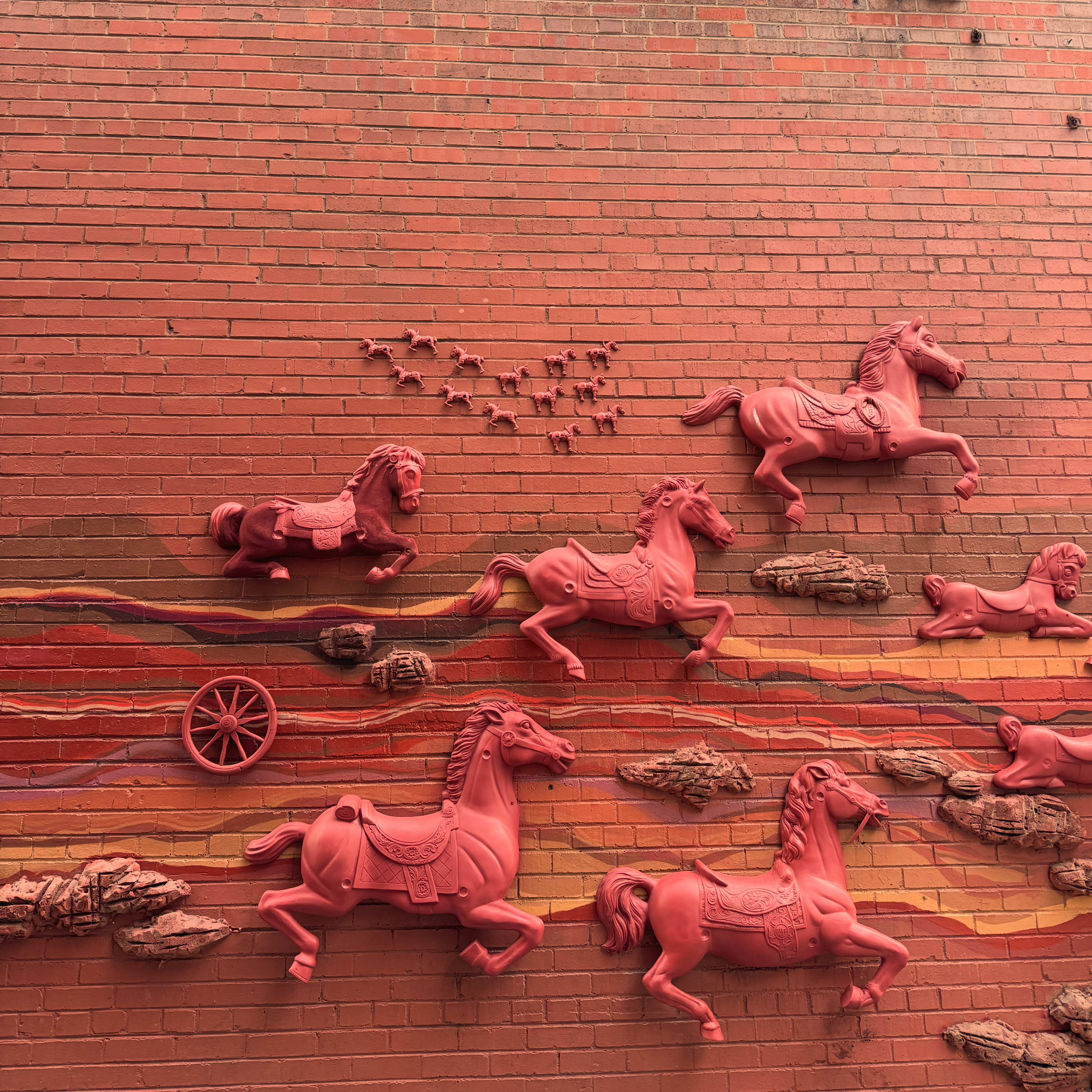
Thank you for the participation and support of 440 international writers who entered our contest. Brilliant Flash Fiction staff members carefully examined those entries and chose the following Top 10 entries with much difficulty. Choosing our top three prizewinners was even more difficult.
Congratulations and gratitude to everyone who earned a spot on our shortlist, and to those who didn’t—we wish you every success in your future writing endeavors.
First Prize: Where Anklets Once Rang by Aleena Abbasi
Editor Ed Higgins comments: Where Anklets Once Rang is a richly told full flash story. It’s every bit what I’d call a WOW+ story.
Where Anklets Once Rang
By Aleena Abbasi
The sunlight seeped through neem leaves, scattering trembling shadows across the stone courtyard. Dust rose only when the wind stirred. The winter sunlight pressed softly against my skin and the fabric of my dress clung lightly to me.
Our old haveli seemed pleased with the morning. Ever since it had been built, it had been the pride of our neighborhood.
Its tall arch stood over the courtyard, steady and dignified. My anklets chimed softly as I walked across the stone floor. Usually I stayed behind the curtains, watching the world through stone carved screens, but today the sunlight had coaxed me outside.
Birds chirped in the trees and my restless heart answered them.
I lifted my gaze toward the jharokha where I spent most afternoons. Its delicate jaali scattered sunlight into lace-like patterns along the walls. From there I could see the narrow road beyond the shisham gate.
And sometimes, if fate was kind, I could see him.
He would pass slowly, pretending not to look up. I would pretend not to watch. Yet somehow our glances always met and my heart would jolt like a startled bird.
Today felt like one of those days.
The wind lifted the edge of my dupatta as I stepped toward the jharokha. My anklets sang softly with each step. Hope fluttered inside my chest at the thought of his footsteps outside the gate.
Perhaps he would pass today.
Perhaps he would look up.
Perhaps it was only his imagination that he saw a woman standing in the old, worn jharokha of the haveli.
The man paused in the bustling street, staring up at the haveli before him.
The haveli stood silent now. Its once-grand arch had cracked with age. Dust and fallen leaves covered the empty courtyard floor. The carved jharokha leaned slightly, its delicate jaali pale from decades of sun and rain.
Yet for a fleeting moment he could almost picture it.
A girl, waiting by the balcony for someone to pass the gate.
Funny thing about old houses, he thought. If you stare long enough, they start telling you stories.
About the Author: Aleena Abbasi is an unapologetic lover of fiction across genres and a playful experimenter on the page. A graduate of English Language and Literature, she spins stories from people and places that tug at her imagination, insisting their tales be told through her eyes. She can often be found admiring architecture of old houses.
Second Prize: One Hundred and Sixty-Eight Days of Luck by Bianca Ong
Photographer Laurie Scavo comments: In a flash of visual brilliance, One Hundred and Sixty-Eight Days of Luck reminds us that everyday magic still exists.
One Hundred and Sixty-Eight Days of Luck
By Bianca Ong
It’s raining, and I forgot to bring my umbrella.
I stand there, shivering, waiting for the bus in Chinatown. It’s Chinese New Year, but the streets are quiet and empty. When it started raining, people flocked indoors, sheltering themselves in the warm heat.
I know these streets like I know my own heart, but it’s been a while.
The loud burst of drums startles me. Ahead of me is a little red blur, a little Chinese lion, dancing around by itself in the rain.
“You can’t catch me!” The child says, lifting the lion head up and jumping. He wears matching red pants with fur lining his ankles and golden tassels hanging from his waist.
I smile, bemused. “Are you lost, little lion?”
A pudgy hand sneaks out from underneath his costume and points up, to where I see a red envelope hanging from the telephone wire above me.
The little lion jumps up, the child’s hands controlling the mouth and opening it wide to snap up the envelope, but it’s too high up for him.
The lion turns to me.
“If you help me, you’ll have good luck for the rest of the year!” The lion promises earnestly.
“And how can you promise that?”
“We’re good luck! When we dance, we scare away the ghosts. Please?”
I pretend to think about it, but it doesn’t take long for me to give in.
“Alright,” I say, and though it’s cold, the boy cheers, still full of energy. “Stand on my shoulders.”
He’s a light weight, and I can hear him hold his breath as he balances on top of me.
“Got it!” The child exclaims, and I set him down carefully, red envelope clutched in his hand as a prize.
Right on time, the bus arrives.
The lion bows to me, and I mimic the gesture.
“One hundred and sixty-eight days of luck. Thank you, mister.” The boy whispers, before running off into the rain.
I smile to myself.
Yet another piece of evidence that magic exists.
And sometimes, it looks like a child dancing around in the rain.
About the Author: Bianca Ong is a student and a burgeoning writer who wants to shed more light on the complex relationships between humans and each unique day-to-day interaction. It is her belief that to make the world a better place, one must write about it, and only by doing so do we get a little braver about our place in the world.
Third Prize: Generational Barbecue by James Knowles
Editor Kari Redmond comments: The voice here is subtle, but fierce, just as the fire is. This piece evokes a nostalgia I love to find in fiction and James does it well.
Generational Barbecue
By James Knowles
I was born on the seam of 1980, between the tectonic plates of Generation X and Millennials, right on the margins where they collide. Apparently, the word is Xennial but that sounds like an anxiety medication, not a state of being.
As a child being disconnected and detached frightened me.
My childhood smelt of warm electronics and cassette plastic. I can trace my life through music format; from parental-vinyl, through cassettes to CDs and streaming, via short stops at MP3s and Mini-discs. Certain albums have been purchased multiple times in varying shapes, before modern life asserted that form was redundant.
My wife is firmly on the Millennial side of the generational boundary. Our friends all seem to be over there as well with the fellow digital natives. I say our friends, but really I mean her friends. The administration of friendship is where I fail. Willingness is present and no lack of effort but, actually negotiating WhatsApp or Messenger or Telegram is beyond my patience.
So that’s how I end up in situations like this, not knowing where I fit. The barbecue is at number 43 and “our” friends are all in attendance. The usual physical divide has emerged now that we’re at the third beer, or second margarita; women near the civilisation of the house, males around the primal flames. The husbands and boyfriends are all nice enough and ask the regular questions. If I was feeling optimistic, I’d say they were displaying a generosity of spirit in including the older guy, but I can detect a definite undercurrent of pity.
But then something happens to change the dynamic. The host has managed to set fire to his merino wool-blend cardigan. The men freeze, their experience of fire is well organised, safety certified bonfire nights. They’re all fascinated by the sight of their host slowly being engulfed. Someone should really do something before this guy is fully immolated, I think to myself as I empty my can of beer over the host and douse the flames.
And then I realise something truly scary—I’m the adult in the room.

About the Author: Jimmy Knowles is an aspiring writer based in the North of England. He has been writing for the last two years and doesn’t really know what he’s doing—but he loves getting words on paper and joining in passionate discussions at his local creative writing group every Thursday.
Notable Stories/Honorable Mention
The Forest Beneath the Lake
By L. Taylor Flynn
Time moves differently beneath the water. Boundaries and distinctions that felt so definitive before, so discrete, seemed fluid to her now. Day and night, which before she would have seen as entities distinct from one another, she now cannot reliably distinguish. Seasons, too, became an arbitrary categorization, the snow and rain and heat and sun coming and going with a continuity becoming of sameness. Everything was everything else, now that she had no choice but to continually observe. Without the reprieve of sleep, of looking away, even of blinking, such constant observation wrests meaning from that which the living delineate.
When awareness first returned to her, and with it the realization that she could see and hear and sense her surroundings but seemingly not affect them, she was preoccupied with watching herself. He had been careless with her body, and the detritus of the lakebed did little to cover her face. She was grateful for this disregard, unsure whether obstruction of her sightless eyes would limit her vision now. At first, her hair floated around her head like a golden halo. The tendrils undulated softly with the gentle current of the lake, and she thought she looked like a mermaid. She had always wanted to be a mermaid, and it pleased her to think that when they found her they would see, at least briefly, how beautiful she was.
Days and months and finally years passed, however, and they did not come to find her. Her hair was the first to change. The current’s tug was gentle but unrelenting, and soon long strands came loose and floated away. Her face, at first so serene that it imitated slumber, gave way to the persistent erosion of water and fish and insects until it too came loose and left her bones. When she could no longer recognize herself beneath the water, she thought perhaps the awareness would leave with her body, floating into the depths of the lake. When it did not, she turned her gaze instead to the forest. Here she watches, waiting and still, without meaning, without change.

About the Author: Taylor is a graduate student studying the effects of psychedelic compounds on adolescent development. Originally from Richmond, Virginia, she now lives in Philadelphia with her menace of a cat, Oliver. Taylor’s ultimate dream is to own a cow; publishing a book is a close second.
MY DAUGHTER
By Laynie Tzena
The teller at the bank is my daughter. The woman leaving the waiting room. The one in the parking lot at Safeway, carefully pulling into the spot she saw from a distance.
She’d be grown now, my daughter, if I’d ever met the right man. What would we talk about? Most things—she’d keep some things to herself, but mostly she’d trust me. Not that I’ve been a good mother. If apologies were coins I’d be a millionaire—I’ve made a lot of mistakes, never having a real mother myself, just a child in pantyhose and pumps.
She’s a good cook—she got that from me—and has an easy laugh, which she got from her father, if there was a father. She doesn’t wonder if anyone will ever love her. She’s known love, imperfect, sure, but love, and that makes her stronger than me. Sometimes she uses that. But she catches herself and does something kind, reminding me I was there for her at this time and that, and saying she hopes she makes me proud. I tell her I’m grateful for her life, whatever shape it takes, and wonder if she can hear how loudly I am cheering her triumphs, or crying when the world breaks her heart.
“I know, Mom,” she says. “You don’t have to keep telling me.”
I finish my transaction and thank the teller. I wait to greet the woman in the waiting room, letting her have the first word. No more spaces in the parking lot.
I wave to the woman getting out of her car and drive on.
About the Author: Laynie Tzena is a writer, performer, and visual artist based in San Francisco. Selected publications: Allegro, Ascent, Bayou, Event, The Lake, MacQueen’s Quinterly, Rabbit, Sonora Review. Betty Crocker’s Unwritten Rules was recently published in Flash Nonfiction Food. Tzena has been a Cranbrook Fiction Scholar and featured performer at the Austin International Poetry Festival and the Marsh, as well as on Michigan Public Radio.
A Herstory of My Deformities
By Roberta Beary
Mother points at my miniskirt. ‘Not a good look with those legs. Unfortunately, you take after your father.’
My older sister joins in, calling my legs fireplugs, sausage rolls, tree stumps. Their laughter seeps into my covered ears. I do the trick Sister Camilla taught us in kindergarten. Guaranteed to keep you from crying. Stare at the kitchen clock, follow the sweep of the minute hand.
My sister says, ‘Your breasts are getting too big. Soon you’ll need a bra for those melons.’
‘Shut up.’
My mother lights a cigarette, narrows her eyes, and says, ‘Your sister was only teasing. You should learn to take a joke.’
I run to my room and slam the door. Take a couple of swigs of cherry flavored cough syrup. Put on my pink flannel nightgown and fall into a light sleep.
I am 14.
***
My husband examines my body after we have sex. ‘I’m not sure how we ever got together, since I like women with long legs. And your breasts are too big,’ The next day he says he’s leaving. I find out it’s with his physical therapist. She’s 15 years younger, flat chested and leggy. In 10 days, I lose 25 pounds. Subsisting on saltines and bone broth. When I force my body into the shower, the water stabs my big breasts and stumpy legs. One day my mother shows up, uninvited.
‘Thank God, you’ve lost weight. I’ve brought you some long dresses. Let’s cover you up,’ she says.
I am 39.
***
Today my legs are translucent tree limbs lightly veined in leafy shades of maple. I rub feet, ankles and calves with lemony cream I special order from Provence. Part of my nightly ritual. My body smells good to me.
‘I could look at you naked forever, but you’ll be wanting this’ my partner says, handing me my silk nightshirt.
I leave the buttons undone. Then shimmy across the bedroom, my droopy breasts bouncing. My fat legs doing dancer’s kicks. My partner applauds. I love showing off my deformities.
I am 70.
About the Author: Roberta Beary they/she, winner of the Bridport Poetry Prize, was born and raised in Jamaica Estates, New York and resides in Bethesda, Maryland. Their work appears in Tiny Love Stories (Modern Love/New York Times), Rattle, HAD, and other publications. Crazy Bitches (MacQ, 2025) is their fifth poetry collection.
MISSING THE WOODS FOR THE TREES
By V. Vaidehi
“Will you do something like this for me?”
Rajat, a few steps ahead, turned around to face Mita, who stood transfixed at the archway. Her face glowed in the light of the setting sun, reflected by white marble. He had proposed to her last month and they were hoping to unite in a traditional wedding in spring.
“Do what?”
“Not exactly build something but do something grand, to declare your love.”
Rajat’s laughter was loud and spontaneous, drawing the attention of a couple of tourists passing by.
“That is a good one,” said Rajat, linking his hand with hers.
A few minutes later, she picked it up again.
“Mumtaz was a lucky woman that her husband, a great Mughal Emperor, built this magnificent monument for her. Truly, this is eternal love.”
“The King was besotted by her beauty, no doubt. But, love?”
A Queen, who was neither the first wife nor the last one but somewhere in the middle of a long list of wives and concubines, became a bone of contention between the young couple. Mita was visiting Taj Mahal for the first time; he had been there several times.
He admired the architectural splendour but did not buy the hogwash surrounding the “love monument.”
“Would you like to be a prized possession rather than be a respected and cherished partner? She was ‘won’ by the King, who killed her former husband.”
Mita stuck to her rose-tinted glasses even when Rajat told her that the Queen died during childbirth, a fourteenth child in that many years.
The monument in white was a witness to their squabble and the cracks that foretold the beginning of the end.
He dreaded a future, unable to live up to the hype and expectations of Wedding anniversaries and Valentine’s days. She foresaw an ordinary and commonplace life, when the world around celebrated romantic love.
The Taj stood in silence, providing the backdrop, when Mita, a middle-aged woman, posed in front of it with her grumpy husband and three children. Rajat never married and never visited the Taj again.

About the Author: V. Vaidehi is an aspiring writer who has not received formal training in creative writing. She writes travel memoirs and short stories, which she shares on her blog at https://vvaidehi.wordpress.com. Her flash fiction stories have been published by Brilliant Flash Fictionand The Centifictionist. V. Vaidehi resides in India.
The Price of Blueberry Jam
By Heather Thompson
Daddy told them to never cross the river. There were tales older than time of magic there, and it would only lead to trouble. But fae trickery that traps even adults often looks particularly appealing to younger eyes.
Hattie and Elisa were tasked with gathering blueberries for jam. The meadows near their little farmstead usually provided an abundant harvest. Their mother had made the best jam; their father was trying his best in her absence.
The clouds had not cried much this spring, leaving the ground dry and sparse. A crisp hint of fall nipped at the girls’ jackets as they foraged further from the familiarity of home.
As they neared the river, voices called from across its banks, soft as whispers on the wind—the best blueberries are here … for a price.
Something flitted between the bushes and pristine blueberries materialized. Hattie salivated at the alluring fruit. She hesitated; the typically aggressive river had dwindled by drought to something easily crossable.
Yes, one for some, we’ll trade you, your blue eyes for berries blue.
“Hattie let’s go back,” Elisa warbled, hearing sharpness in what was trying to be a pleasant melody beckoning them across.
“Don’t be silly, Daddy said to bring back full baskets,” Hattie called, splashing through the diminished water. She began plucking blueberries as small green figures twinkled around her.
A fae trade is never a fair one.
Hattie’s satisfied laughter turned to panicked screams as the creatures whipped into a feverish whirl. “Elisa, help!” she shrieked, but Elisa felt rooted in place, watching as her sister disappeared behind a wall of wings. She squeezed her eyes shut, wishing their mother was here.
An unnatural quiet settled. Elisa hesitantly looked and saw Hattie hunched over.
“Elisa? Why is it so dark?”
Hattie turned towards her sister, her beautiful blue eyes now an empty grey. As understanding of her blindness set in, Hattie screamed, stumbling back through the stream.
Elisa grabbed her hand, dragging her in a panicked sprint home. They left behind the blueberries that were so costly, and the now bright blue sprites’ fading laughter.

About the Author: Heather Thompson is an aspiring author but current emergency manager and disaster recovery outreach coordinator. She is interested in pursuing writing within the fantasy and horror genres. She loves rock climbing, hiking, woodburning art, and reading for book club. She lives in Philadelphia with her partner Kevin and her two cats, Loki and Jasper.
Piss in the Bushes
By Anthony Galindo
Tori let Jacob complain all morning about his three-month girlfriend, but she draws the line when coworkers bring their woes into the break room.
“I guess the problem is that I’m too nice. I care about Jessie too much to hurt her, but that doesn’t necessarily mean she’s the right girl for me. You know what I mean?”
Tori chucks her Tupperware into the microwave, “Oh my god, dude, you’re pathetic.”
“Are you even listening to what I’m saying?”
Tori snaps, “Yes, Jacob. I’ve been listening all day long.” She picks imaginary rose pedals, “I love her, I love her not. I love her, I love her not. You’re just too much of a wimp to make a tough decision. But that’s life; sometimes you need to just get it over with and piss in the bushes.”
“Piss in the bushes? Jacob says bewildered. “That metaphor doesn’t make any sense! Everyone likes to piss in the bushes.”
Tori erupts, “Boys! Boys like to piss in the bushes. Girls hate it! I don’t go camping for one very specific reason: I prefer indoor plumbing like a civilized human being. My genuine hope is that, for the rest of my life, every single drop of my piss goes into a toilet. But every once in a while, my stupid boyfriend drags me on one of his stupid hikes, insisting that I hydrate because,” her voice mockingly drops an octave, “you need to drink more water and less iced coffee.” Her usual tone resumes, “So, by the time we get to the top of the mountain, I need to make the tough decision to squat behind a bush and hope I don’t splash pee on my ankles. But that’s life! Sometimes it deals you a bad hand, so you have to make the tough decision to bite the bullet, piss in the bushes and get it over with!”
Jacob whispers feebly, “Good lord,” looking scared.
Their long silence is like static electricity.
Jacob leans forward, “So, you’re saying that I should break up with her?”
Tori slaps her palm against her forehead.

About the Author: Anthony Galindo—”This story is a tribute to my favorite coworker whom I would pester relentlessly about my immature and predictably unsuccessful dating efforts. I’m glad that I finally learned to piss in the bushes and give myself a shot at finding true, intentional, unselfish love.”
E for Intelligence
By Uchanma Kama
I’d been a court clerk for seven years. Seven years of filing disputes that usually spilled into “F u’s” and “B words” until the bailiff bellowed for order.
That was normal but nothing prepared me for the words I was currently filing.
Emotional Damages Vs Artificial Intelligence.
I blinked and checked again. Not a typo.
Court proceedings began and I sat at my table, carrying out my ever faithful tasks. The plaintiff looked like he just stepped out of a Balenciaga magazine, flipping his side curls to punctuate every sentence.
He accused the defendant—his girlfriend of cheating on him and as such should pay for damages incurred.
I stared down at my keyboard. We’d seen more absurd cases.
The judge asked who she had cheated with and he answered with a small frown.
“ChatGPT.”
The silence was so deafening, I heard the judge’s pen scribbling. I glanced at the audience. A woman was giggling in the gallery, another stared at the plaintiff with an incredulous look.
He went further, listing the bot’s heinous crimes; it listened, flirted and responded on time, stealing the attention he needed. My hands flew across my keyboard, shaking my head at the absurdity.
Someone laughed and was quickly shushed.
The defendant didn’t object.The bot made her feel seen, she said. It didn’t call her lame or too much or attention-seeking. The plaintiff countered, saying he was present all the time.
“You were present but never with me,” she said.
I typed this down wondering when being present wasn’t enough.
Exhibit A was submitted: printed chat transcripts. It was polite, patient and kind.
After a brief deliberation involving several expensive-sounding words and no clarity, the court subpoenaed the artificial intelligence itself. Its response was read aloud.
“I do not form emotional attachments.”
The judge sighed. The case was dismissed on the grounds that the law did not recognize artificial entities as romantic rivals. We all stood and the room emptied.
Later, at my desk, I checked my phone for the message I’d sent my husband before work.
Seen, yet no reply followed.

About the Author: Uchanma Kama is a Nigerian writer whose work explores identity, womanhood, and the politics of space and self. She writes poetry and prose that interrogate societal expectations, personal freedom, and the messy, beautiful realities of life. Her work “Circumference” has been published in Brittle Paper.
 BRILLIANT FLASH FICTION