
GRADUATION DAY
By CC King
A four-by-six color photograph of my father and me staring out over the field behind the gymnasium at my high school. The picture was taken in San Jose the day of my graduation, in the late 90s. My father and I are facing away from the camera, and even through the grainy pixels, it’s clear his hand hovers inches from my back, which is draped in a black gown that was never pressed—the folds from where it was boxed and shipped make the shiny fabric bend and catch the early June light. My father is telling me about my sister, about how many days he thinks she can last on life support, about how difficult it is on my mother, this decision looming before them, about how it can tear marriages apart. I remember that, though I don’t recall much of the graduation ceremony. Only being pushed from behind when my name was called, and the roar of applause and cheers as I made my way across the stage. Even then, I knew it was less an ovation for me than for my sister. Her graduation would be of a different kind.
Some other details stand out. Smiles everywhere. Balloons floating like severed heads to the rafters. Faces swarming me like bees. And my father, making his way to me after the formalities were over. His shoulder pressed against mine as parents and teachers and administrators pushed into us. How without saying a word, he cleared a path through the crowds of happy relatives and friends, shouting to each other over the cacophony of other happy relatives and friends talking about bright futures and roads ahead. The way he paused at the edge of the field when I did, inhaling the sweet scent of cut grass, instead of striding toward the car to beat the other cars out of the parking lot.
And how, when the well-meaning mother of a once-friend called out to us, encouraging me to come to her daughter’s graduation party—Just for a little bit, to take your mind off things—he stood in front of me, narrow shoulders expanding, staring her down until she moved on. The way he reached over and squeezed my hand before backing out of the parking lot and driving us back to the hospital, the silence between us louder than the din in the old school gym.
I Imagine My Face on a Freeway Billboard
By Mae Ellen-Marie Wissert
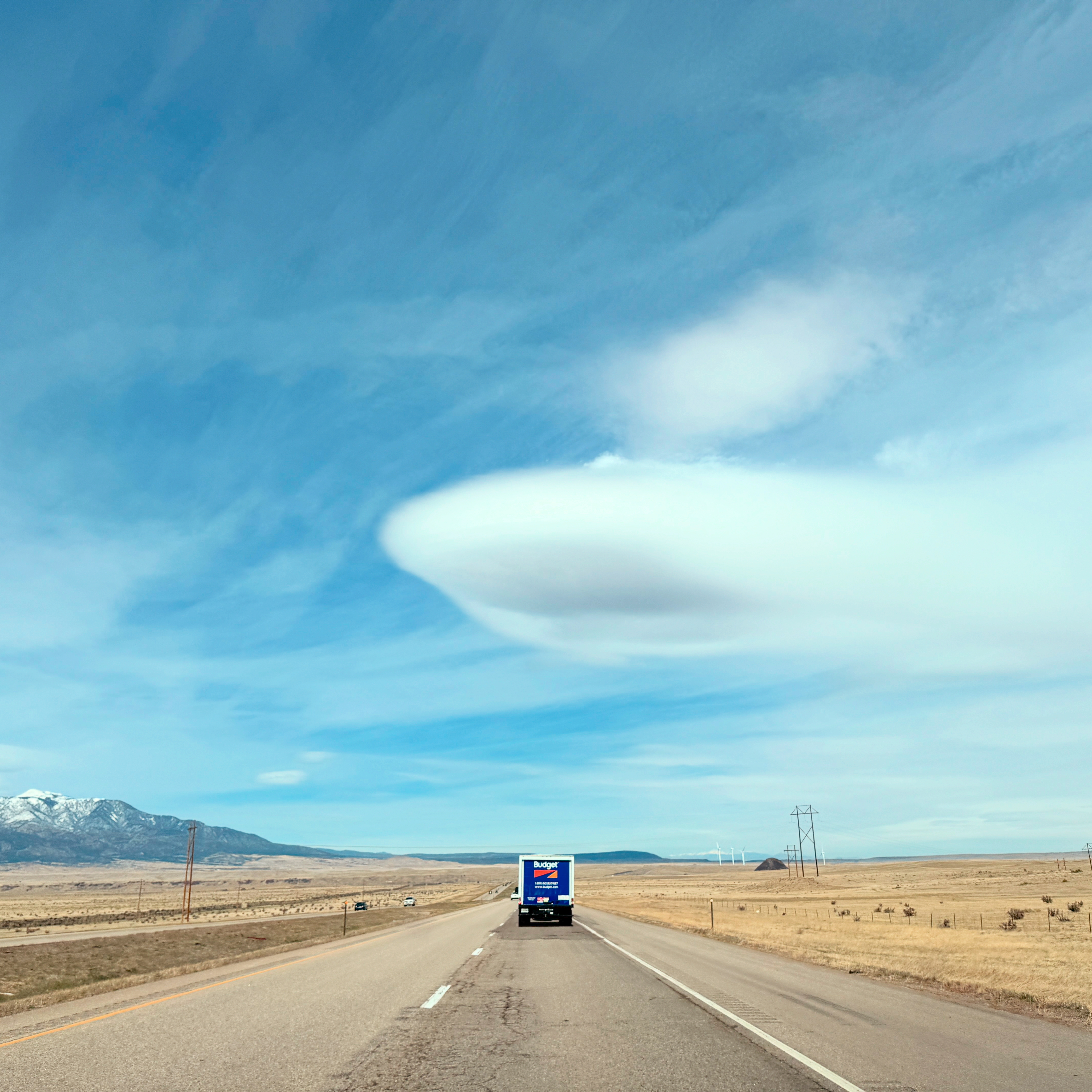
Some people praise Lana Del Rey’s extravagant pettiness for placing the one and only billboard promoting her new album on the Tulsa freeway her cop ex-boyfriend drives every day … and I am those people. But I am not making Los Angeles money and can’t afford a billboard in our small town. So, I settle for the rare opportunities when my ex’s Cadillac passes me on our main street.
I look past him: my face framed in a rolled-down window of a failing 2004 Chevy Tahoe I can barely afford, with pink sunglasses, fake gold hoops, a candy necklace and an American Spirit hanging from my mouth, hoping this glamour will remind him of what he lost.
Spread fingers to my mouth—I fix my glossy gaze beyond the glare of his windshield while I remember our arguments—where he mocked me then told me he loved me. I recorded them so I could play them back to him to show his malice like maybe then he would change. Instead, the recordings demonstrated me eating that shit up. He never heard them, but I still listen when I miss his authoritative voice. My own cracks when I say stuff like you can’t treat me like this. I knew he could. In the car: I appear as lackadaisical as Lana on that billboard: her cat eyes looking everywhere and nowhere.
Lana said the reason for their breakup was demanding schedules, but at an award ceremony her ex kept stepping on the train of her silver beaded dress. When my boyfriend wasn’t paying any attention to me, I carved the meat of my leg with a dull kitchen knife until the cops showed up. I put the stained knife on the white countertop and sat on the porch of chipping concrete, blood soaking through my jumpsuit. I shouted across the picket fence I was so much happier before I met you.
I can’t recall how true that is, but ever since he left my front yard, I’ve missed how it felt in his passenger seat while he gripped my thigh and called me baby; to be pacified. Cradled. Once, in the middle of the night, we drove to Salt Lake City.
We passed floodlit signs offering help and providing warning for those succumbed to addiction—examples made with sun-bleached and peeling vinylated young, beautiful faces that are no more—a reminder: this could be you. On our way home, morning light spilled through my heart-shaped sunglasses and warmed the sepia billboard of a beautiful realtor on the border of my town: her blonde hair blowing in the wind beneath a cowgirl hat and a blurred barbed wire fence in the background. Now, I chew my candy necklace. O Lana, O drug addict, O realtor, what is it like to be so seen?
Solution Oriented Thinking
By Rory Perkins
Problem: My brother is going to kick me out unless I stop drinking. Says his house isn’t my personal rehab.
Solution: I’ll cook him his favorite meal and beg him to stay. Maybe I will bring up that time I told Mrs. Hinch it was me who put gum on her chair and not him. Maybe I’ll just cry and hope for the best.
Problem: I’m a shit cook.
Solution: Tesco.
Problem: The horses took all my money. Or rather, I had a tip that didn’t play out, and my horse lost, broke its leg, got shot just off camera. Last week I promised my brother I had quit gambling.
Solution: I know where he keeps his cash stash. Calls it his rainy-day fund because every time he buys coke he makes sure it’s pissing it down. His way of making peace with himself. Playing a joke on life. He won’t mind if I take a bit. Not with the job he has, which is plumbing, or electrician, or something. I dunno. Didn’t ask.
Problem: It’s been three days since I had a drink. Follow up problem: I don’t know what happens on day 4.
Solution: Get some vodka at Tesco. Say it’s for the lasagna. Penne alla vodka is a thing, right? Why not Lasagna alla Smirnoff?
Problem: It’s taken most of the day to come up with the Lasagna Plan. The morning I spent collecting some of his jewelry and putting it at the bottom of my suitcase. Just as insurance, so he doesn’t feel like he has to offer me cash. Avoid unnecessary conversations. Now there’s two hours until he’s home.
Solution: Take his truck. Grab a microwave meal instead, plus the vodka. He’ll never know the difference.
Problem: I have already drunk some of the beers in the fridge. Or maybe it’s all of them.
Solution: I’ll add some to the list. Down a coffee before I go, to sober up.
Problem: The coffee was decaf and now I’m doing sixty kinds of tipsy.
Solution: Keep going. Pedal to the metal. The quicker I get there the quicker I can get back and have a nap before dinner.
Problem: My motor control isn’t great. Truck shouldn’t be heading for the central reservation. I shouldn’t be staring into oncoming traffic.
Solution: Pray
Problem: I’m an atheist. Bigger problem: I’m about two feet from smashing into the underside of a fourteen-tonner with nowhere to go.
Solution: N/A
Problem: The guy standing over me isn’t my brother. He knows my name and keeps asking if I have any allergies like he’s cooking me a fucking steak sandwich. Then he jabs me in the chest with a needle.
Solution: Leave
Problem: I still haven’t got any lasagna.
Solution: Go home, order from the Italian place nearby.
Problem: My legs have been relocated. Repurposed. They are laid out on a plastic sheet to my left while a guy in a mask pokes them with a metal stick.
Solution: … fuck.
Problem: I can teleport. Or at least, I’m not in the same place as when I closed my eyes. There are whitewashed walls rather than tarmac and a sheet instead of the space where my legs used to be. My brain isn’t having it, tries to relinquish consciousness.
Solution: Ask my brother, who has appeared next to me, who is looking at me with something like pity so maybe all is forgiven, maybe I won’t have to cook the lasagna, and he’ll let me stay after all.
Problem: The rest of my family is here too. Most of them I haven’t seen in years, so they don’t know about the redundancy, or the divorce, or the drinking.
Problem: No one is smiling.
Problem: I want to tell them I’m sorry but there’s something blocking my throat.
Problem: Words aren’t enough.
Problem: My mother is crying in the corner and now everyone knows her son is a fuck-up.
Problem: I have nothing to live for.
Problem: I’m not even sure my brother likes lasagna.
Problem: I still have nowhere to live.
Solution: Wait until it’s just me and my brother. Ask for a pen and write I’m sorry for the first time and mean it. Ask if he can help me get set up with my own place. Try not to cry when he hugs me, saying yes. Saying of course, I just wish you’d asked sooner.
Dog Day Afternoons
By Keith J. Powell
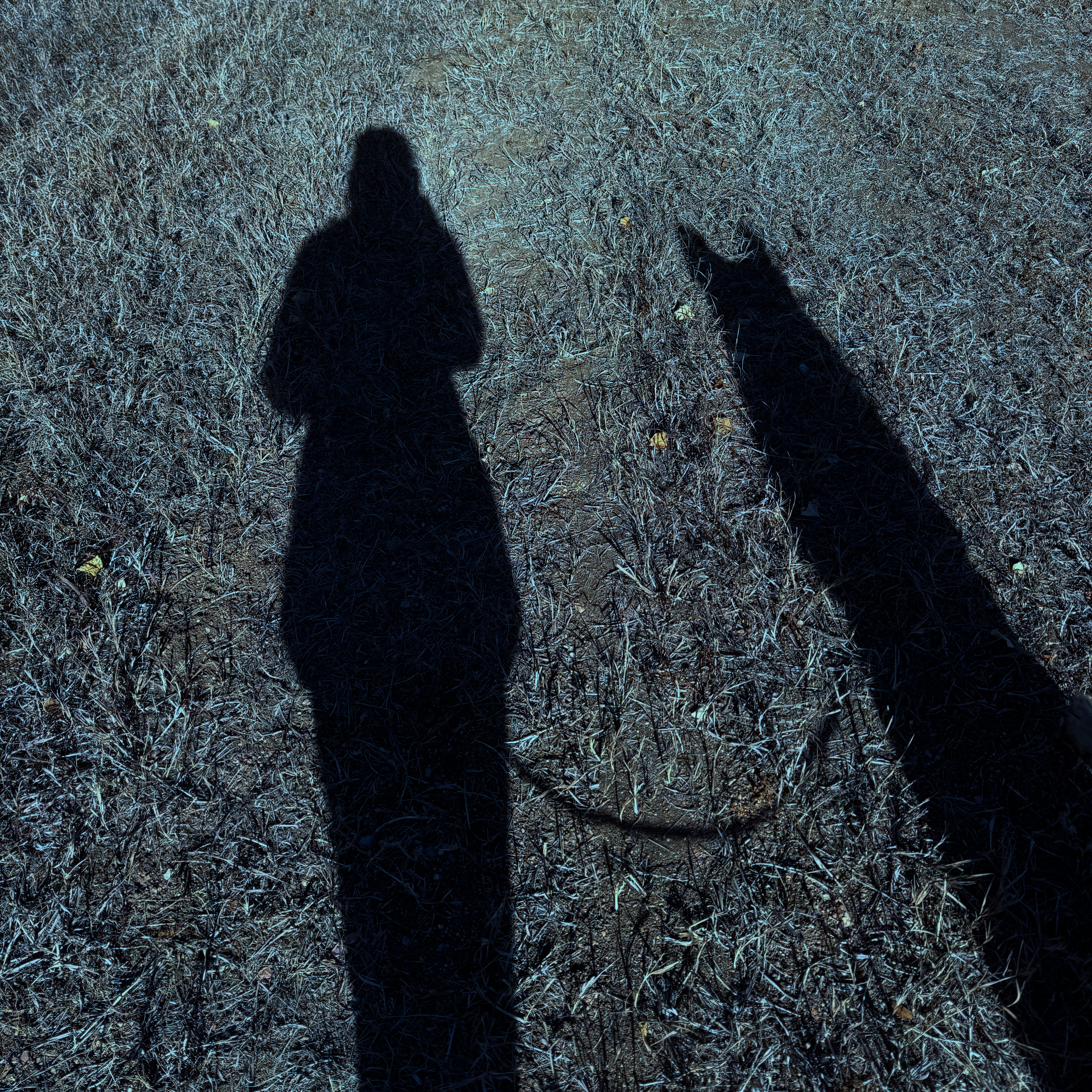
Mark adopted Virginia from the Champaign County rescue a week after the layoffs. She was an improbable German Shepherd-Mini Pinscher mix with a black domino mask and puppy-white canines that twinkled like opportunity. Mark didn’t quite remember how he arrived at the rescue or why he had gone there in the first place. He only remembered spying Virginia in her cage, her tail thwapping the ground like a giddy metronome, and thinking, this is my dog. This is my partner in crime.
It took them time to find Virginia’s voice. Jen heard a kind of Victorian-era dynamo—an Adderall-powered blur of manners and cheer. Mark, on the other hand, heard a cunning folksy drawl, thick and syrupy like French toast from a roadside diner. Since Jen was gone at work all day, Mark won.
As the summer dragged on, Mark struggled to adjust to his new equilibrium. Bills piled up. Interviews dwindled. Jen packed her bags. Finally, it was just Mark and Virginia camped in front of the TV, dissecting the surprise Zoom meeting that had punctured his life so completely—time and days an abstract delineation no longer serving any real purpose.
“I’d never even met the guy before,” Mark said. “Did I already tell you that? He was a stranger. Just a face from HR. Excuse me, just a face from Talent Management.”
The pair were lying on the living room floor, watching a movie starring a young Al Pacino.
“I should have said something, done something,” he said. “I should have gone down swinging.”
Suddenly, Virginia sat up and dropped her favorite chewy, a bright orange barbell with a dead squeaker.
“Sir,” she said. “May I be so bold as to propose a daring doing?”
“I’m listening,” Mark said.
*
Mark strolled into Third National Bank just after the lunch rush, Virginia tucked under his arm like a quarterback posing with a football. They waited in line patiently until a teller with a head like a candied apple, round and red and shining, motioned them forward.
“How can I help you?” she asked.
“Empty the register, or the dog gets it,” Mark said.
“Ma’am,” Virginia whispered. “Reckon you best listen to him. He’s fallen on hard times and’s got nothing left to lose.”
Still the One
By Ed King
I’ve decided to leave him.
The fluorescent lights of the pharmacy fight back the night outside. The rain drips in the puddles. I scan the shelves. There are two kinds: one with progestin and estrogen and one with only progestin. Which one do I need? Nobody told me.
“Excuse me, señora. Are you okay?”
A woman looks at me with concerned eyes. She is older than me—I’d guess she is in her 40s. She is well-dressed and glamorous. I would bet that she works a respectable office job nearby, while I work at a school out in the sticks.
I must have looked like I was crying. I’m not crying.
“I’m fine.”
“Okay—you don’t look fine, if you don’t mind me saying.”
“My husband has signed up to fight in Ukraine.”
I don’t know why I said this. It isn’t true. I just wanted to say something to explain why I was crying in a drugstore.
“Do you speak Spanish?” she said.
“Claro.”
She switches to Spanish.
“So, your husband—how long have you been married?”
“Oh, I—” I lied. “We’re not married. We’ve been together for—” I think about it “—seven years, now.”
I think about Paul. His good-heartedness, his diffidence. His scruffy beard. Handing out fliers for Catalonia. How young we were then.
She seems to read my mind. “You’re so young,” she says. I don’t feel it. I feel old and weary and old.
“I’d love to buy you coffee or dinner,” she says. She fishes a business card out of her purse and hands it to me. I put it in my pocket.
“Can I give you a hug?” she says. I acquiesce, but I don’t let myself be drawn in. I stay stiff. She squeezes me and says, “You’re a strong woman,” in a trembling voice. I don’t feel strong. I feel weak and foolish. She walks up to the checkout to pay for her makeup. She unfolds her umbrella and disappears into the night.
I pick a box at random from the shelf. It is oddly light. I walk up to the checkout. Two young women stand at the register, exuberant with talk. One of them is saying: “But Eugenio is always looking for other women.” The other says, “I’ve told you so many times.” They notice me standing there and one of them takes the box out of my hands. She looks at me with what I think is pity or concern before she rings me up.
Still the One by Shania Twain plays through the speakers. I remember driving along some Colorado road with the windows down, my dad behind the wheel, that song playing on the radio. We listened to it all through that road trip. It was on the radio every day. I remember loving it, and how it made me feel so safe and warm.
I remember my mother setting up the tent while my dad drank beer. The cool air so unfamiliar. My dad in his warm leather jacket and my mother shivering just a little. My dad picked me up and pointed at the stars. “Look at that one there, that’s not a star; it’s Jupiter.”
I remember waking up in the night and going outside to pee. It was cold, and the stars were bright. I could hear my dad and my mom talking, but I couldn’t hear what they were saying. Their voices and the cool air made me feel like I was home and somewhere very foreign at the same time.
I leave the pharmacy and walk into the rain, feeling the cool air, feeling myself getting wet. I take the box and look at it for a moment and then put it in the trash can in the street. I find the woman’s card and throw it away as well. I walk back towards our apartment. I wonder if he put on the tea.

High on a Hill
By Coleman Bigelow
In another life, we’ll meet at the top of Russian Hill, the way we used to on Thursday nights. A gust of wind will flip your hair across your freshly glossed mouth and I’ll pull the stray strands from your sticky lips and kiss you, no longer worried about your signature crimson tattoo. We’ll be breathing hard from parallel climbs to our apex meeting point: that glorious intersection atop Hyde and Lombard where the houses form their own geometry with the slanting streets and where, on a clear night, you can see Orion’s belt hanging just above the Golden Gate. You’ll smile wide enough to let your snaggle tooth sneak out, and my stomach will fizz at the sight because you don’t release that canine for just anybody. I’ll joke, “What brings you here?” and you’ll say, “I’m here to see a man about a horse.” “Hop on,” I’ll offer, while leaning over to let you climb upon my thickened back. Then I’ll trot along, while making my best horsey noises, as we head toward the twinkling lights of our favorite Italian spot. You’ll order your favorite Pumpkin Ravioli with the brown butter glaze. And the raviolis will glisten in the candlelight and the flickering flame will reflect in the three-sided glass of our window table and we’ll stay cradled there in that cozy corner’s embrace. I’ll slide my hand across the crisp white cloth and, instead of clasping nothing more than my phone, your hand will be waiting.
In another life, I won’t be lingering outside the moment, staring solo down the twilight of “our” years. I won’t be slouching in the fluorescent glare of a Nan Xiang Express and scrolling through photos of your latest river cruise. I won’t be studying shot after shot of you smiling alongside your grey-bearded boyfriend, who the kids all seem to like. In another life, I’ll never have to pinch and zoom and pray for no sign of snaggle.

The Surgeon
By Lorette C. Luzajic
Hannah is glowing, he can tell already from the front door, from the scent of spices and garlic, from the sounds of sizzling and bubbling and funky jazz. Jamiroquai? It’s been a while.
Mike kicks off his work boots, grinning widely before he gets to the kitchen. Hannah grins too and points to the faucet when he reaches for her. First things first. “Who knows where those hands have been,” Hannah says, a bit of the old her surfacing in her expression, as he scrubs the cars of the day from his fingers. Mike sees that she has already uncorked a nice bottle of Malbec to aerate.
“Well, don’t keep me hanging,” he says, pulling her close. “Good news, I’m assuming?”
Hannah had not been as anxious this year as she’d been for previous follow-ups and scans. Her team saw no reason for concern, with all of her markers showing consistent improvements and nothing worrisome. Still, recurrences were common, and it was natural to fear them. Every No Evidence of Disease report was a landmark.
“All clear,” Hannah nods. Mike scoops her into his arms. He doesn’t try to hide his relief, kissing her head and face. When he pulls away, Hannah sees his cheeks are streaming tears. His hands move over her apron for a friendly fumble of her breasts. “Good girls,” he says, squeezing both gently. They are soft now with late middle age, and underneath, one is smaller, uneven and missing a nipple. But they’re there, and Hannah is here. He’s caressing them and kissing her neck now. He can’t help himself, the relief.
“What did Dr. Shahan say?” he asks.
“Not too much,” Hannah replies. “She said right away that the scans were all good, asked if I had any concerns.” Hannah smiles, remembering the moment the surgeon strode into the little room where she was waiting, shivering and exposed in a flimsy paper gown. The doctor put Hannah at ease right away, didn’t make her squirm for the reassurance she was waiting for. Dr. Shahan was a world-respected oncology surgeon. She was a wonderful doctor, a straight shooter, smart, and warm. And gorgeous. Amazonian tall, and big curly hair. She wore curvy sweater dresses with sneakers.
Like every woman, Hannah hated all the appointments and the treatments. She associated most of the health care team with trauma and didn’t care for their ways. She always felt like cattle. Or worse, like a good repeat customer. Go here, do this, stand here, poke, prod, click, clack. But she had had a little crush on Dr. Shahan. Something about the doctor’s confidence and authority. And how she smelled like warm vanilla, like toasted marshmallows.
Of course, Hannah understood that lots of people developed unexpected attraction for a therapist or doctor. When someone nurtures you or saves your life, it’s a powerful aphrodisiac. In the days that she was as bald as he was, while she was hunched over the toilet, she used to joke to Mike not to be surprised if she ran away to Costa Rica with Dr. Shahan.
With his hands all over her, swaying in the kitchen, with a slow beat and husky voiced Prince now crooning from the playlist, she can’t help but thinking of the old days when they used to make love in the kitchen. Make love anywhere, everywhere. Mike was a skilled mechanic. He was good with his hands. They still made love today, but it wasn’t like it used to be. The forced early menopause from chemo and losing half her breast had been hard on her. She missed this part of herself. She missed Mike, too, even though he was nowhere but here.
Hannah is getting lost in the slow dance, in sultry memories. In the glimmering images in her mind of Dr. Shahan’s latex hands pushing her gently this way and that, tugging her breasts. “Dr. Shahan looked fantastic,” she whispers suddenly, a catch in her throat.
“Tell me,” Mike says after a while. “Describe what you see.” She finds herself sliding down onto her knees, her hands spread wide stroking Mike’s big belly, fumbling at his jeans. Her husband starts to groan.
In the back of her mind, she is aware of the untouched wine that they will pour after this. She can smell the paprika and fish and lemon, the bright, fertile scent of life, hear the stew bubbling over.
She thinks about how vulnerable her body was on the operating table. The feeling of fear, of trust and pain and letting go. Dr. Shahan teasing her flesh open, cutting in to her tender flesh with scalpel and lancet, taking the diseased part of her away, cutting her back into wholeness.
Khichdi: A Recipe
By Sushant Malhotra
They refuse at first. “Liability,” they say—a term I have come to detest ever since I stepped onto this land as an immigrant years ago. “I want khichdi,” I repeat, on a sweltering day in Delhi, a small town in Texas I settled in because its name reminded me of home. A few calls are made. An ad is issued in the Delhi Daily. One chef replies. He mentions his “chicken tikka masala.” I’m tired of mainstream. I long for my mother’s cooking. “Khichdi and nothing else,” I insist.
The jailer is puzzled. “Ain’t you a hoot,” he says, with a southern drawl, his bushy black eyebrows furrowing.
“It’s comfort food,” I reply.
He’s never heard of this simplest of South Asian dishes. I don’t blame him. I, too, had never heard of “country fried steak” before stepping onto this land that, in my imagination, was populated by cowboys and coyotes. After some back-and-forth, my request is forwarded to the warden. The reply is swift.
“Never before has anyone in your situation been allowed to cook, but given the recent budget cuts, and the esoteric nature of your request, an exception has been made.”
It’s odd how something simple in one culture can be deemed esoteric in another. My prison defines the “irreversible cessation of circulatory and respiratory function” as death. Growing up, my mother always said the body is just a vessel for the soul, which never dies—only reincarnates or finds liberation. I wonder if her soul has found another body.
On D-day, I find myself in a massive industrial kitchen lined with rows of Bunsen burners, hot plates, and food processors. The place smells sterile—a mix of bleach and lemon. In the far corner sits a guard dressed in khaki shirt and trousers. All the ingredients are arranged on a cold metal countertop: white basmati rice, moong dal, cumin, dried red chilies, whole black peppercorns, ghee, bay leaves, and salt.
I wash the rice and lentils, soaking them in separate containers. Half an hour later, I drain the lentils to remove the bitter-tasting saponins and transfer them to a pressure cooker. One whistle is all they need. Meanwhile, I heat ghee in a cast-iron pan for the tadka. A nutty warm aroma suffuses the cold, dry air. The guard, who has been sitting stiff and stoic, sniffs repeatedly. He licks his lips, just like I used to while watching my mother cook khichdi on crisp winter mornings. “Someday, you will make me proud,” she used to say as she spooned the rice-lentil porridge into my mouth.
The cumin splatters in the hot ghee, followed by the red chilies. Bay leaves and black peppercorns go in next. It’s all over in a flash just like life itself. I’m wondering if my soul will ever meet my mother’s when the pressure cooker whistles. The lentils are nearly done. In goes the rice. The late addition ensures the grains don’t overcook but come out fluffy. One more whistle and the cooking is complete. I pour the tadka over the medley of lentils and rice. The ghee, infused with spices, sizzles. I blow on a steaming spoonful before tasting it.
A wave of contentment washes over me. I’ve never dared to cook this sacred dish before, afraid I don’t deserve it. My lips quiver as I whisper to my mother—“How I wish you could have tasted it, Ma,”—she who passed away waiting for her son because he didn’t have the right papers to travel.
I eat bowl after bowl, savoring every bite. The guard watches me expectantly. I save him some. When the final bell rings and it’s time to go, I am ready. A warm, fuzzy feeling fills me as the needle pricks my skin, as if my mother’s arms are wrapped around me, just like the day I was born.

Hands
By Gary Fincke
Since you were thirteen, you have worked Friday nights, seven to ten, in your father’s bakery. Doing the simple things. Greasing pans. Chopping and weighing dough for bread. Cupping the palm of your right hand to roll small chunks of it into balls that will swell and bake into sandwich buns. Your father uses both hands, forming perfect spheres every time, but your left hand rolls nothing but turds.
After you turn sixteen, you work Friday nights from ten to five-thirty in the morning, driving yourself home so your mother can take the station wagon back to the bakery and begin selling at six o’clock. Even now, you can’t use your left hand for sandwich buns, and one night, as if he has researched your handicap, your father tells you about the surgeon Celsus, two thousand years ago, who performed cataract surgery, training his right hand to operate on the left eye, his left hand to repair the right. He says that Celsus removed cataract after cataract, inserting his needle, nudging them off-center. “Like when one of your contact lenses slips to the side,” he says. “Left, then right-handed, both eyes cleared thousands of years ago.”
That Sunday evening, he shows you family photographs. He asks you to look from left to right at the pictures of husbands and wives and their children through five generations that begin in German scrawled unintelligibly across the backs of the oldest two pairs.
For a minute, you expect that your father will translate whatever messages had been written by the couples who had been born somewhere other than Pittsburgh. So far, like the left-hand layup you’d given up on, a second language has failed to enter you, and you listen when he says German had been forbidden in his house as much as taking God’s name in vain, that he had put aside Kraut and Heine and worse, slurs you would never hear, even if there were another war, because his parents had made sure German dissolved.
He touches each photograph twice, moving from left to right as if he expects you to remember. “I only know the ones on the right,” he says. “My parents and grandparents. The others are lost.”
The next Friday, you stand and watch while he rolls sandwich buns with both hands at once, spheres so tight that you can’t tell which had been formed from the left or right when you exchange an empty baking pan for the full one. Cautiously, without speaking, you lay your left hand on his right to follow its circle. “Yes,” he says. “Now you,” like Celsus, the cloud remover, teaching a miracle to his disciples in the eternal language of the hands.
The Events at Helena’s
By Philip Matcovsky
Her hand dances over the skillet, spooning butter on the quail repeatedly. The spoon beating evenly on the cast iron, the smell of rosemary and thyme browning. Her energy in the kitchen, her focus, clears all other thoughts.
After dinner, Sonya replaces her house shirt with a white button down, a navy jacket with piping on the cuffs, and a navy tie. Her work uniform as doorwoman at The Kattinghton luxury apartment building.
She opens the door for the residents leaving for dinner. Singles, couples and families. Some slowing down to ask how she is, others giving a nod. Sonya prides herself on being professional, maintaining boundaries, speaking to the residence about themselves and not her own personal life. However, there are friendly residents, like Eddy and Edwina, with whom she is more casual.
They approach wearing gym clothes. With eye contact, they simultaneously offer a giggle.
“Good evening, ladies. Heading to the fitness center?”
“Yes, dear,” Edwina replies. “I have a mean trainer. But it works for me.” She throws up a lanky arm and flexes her muscle. “And we may hit Helena’s afterwards for dinner. Will we see you there in your toque?” Sonya has their full attention in the time it takes her to respond. Eddy and Edwina have the same elegant face, despite the age difference. While they look like grandmother and granddaughter, they say they’re not.
The first time Edwina mentioned toque, Sonya googled it to discover it’s a chef’s hat. Eddy and Edwina are strangely serious in their belief that Sonya moonlights as chef at Helena’s. It seems impossible to convince them otherwise.
Also strange is how they are both named Edwina. Upon meeting them, Sonya loved that and said so. When the giggling stopped, they corrected her. Their names are different. Even during their second encounter, after referring to each other as Edwina, they denied having the same name. To make things easier, Sonya asked permission to call the eleven-year-old, Eddy. The tall one would remain Edwina.
In a deadpan tone Sonya tells them, “As you know, I’m not the chef at Helena’s.” She feigns a smile.
“Then why not meet us there for dinner tonight?”
Each time Sonya declines their invitation, she feels implicated. But she is simply uncomfortable meeting residents outside of work. In fact, she would like to see the chef, to better understand Eddy and Edwina’s humorless accusation. To that end, she could arrive at Helena’s shortly before it closed to reduce the risk of seeing any of her residents. Maybe even take a photo with the chef for Eddy and Edwina.
Sonya asks for a table for one. She’ll only be ordering dessert tonight. There is an immediate sense she’s seen this restaurant before. The dramatic crown molding. The open kitchen creating both a welcoming and a private space. She studies the dessert menu when seated. It’s between the cinnamon-honey phyllo triangles filled with Greek custard, and the goat’s cheesecake with figs and honey. She decides on the latter.
After ordering, Sonya strolls close to the kitchen on the way to the ladies’ room. She stops directly in front of it, waiting for the chef to be in full view. Like herself, the chef is slightly pear shaped, with the same heavy ear lobes and tight hairstyle under her toque. The chef turns. There is instant recognition. With certainty. As with Eddy and Edwina, there is no doubt. She is looking at herself. It is her.
Rather than continuing to the restroom, Sonya moves back to the table to leave cash for the dessert she will not taste. She takes a taxi to her apartment but does not get out until the driver tells her they have arrived. She is consumed by thoughts of what she saw at Helena’s. There is no logic to it. She needs to change her focus to calm the beating of her heart. She decides to prepare a chocolate espresso mousse. Tomorrow she’ll question Eddy and Edwina. Hopefully they’ll have something insightful to say of the events at Helena’s.
Sonya falls asleep only two hours before her alarm wakes her. Most of the night found her eyes open in thought. She rises with a sense, a hazy remembrance, that she’s had an out-of-body experience while asleep. Soon after, she slides into a pair of jeans and a hoodie and makes her way to work.
At the restaurant, she changes into her chef whites, the double-breasted jacket, the toque blanche. She watches the dinner crowd slowly arrive. About half the diners are regulars. The tall older woman who dines alone is there, at her usual table reserved near the kitchen. Sonya recalls her last visit—the pistachio-crusted sea bass made her giggle, indicating her approval. She mouthed “bravo” to chef Sonya. Always a professional, Sonya visited her table to express gratitude for her patronage.
The Lighthouse Keeper
By David Waters
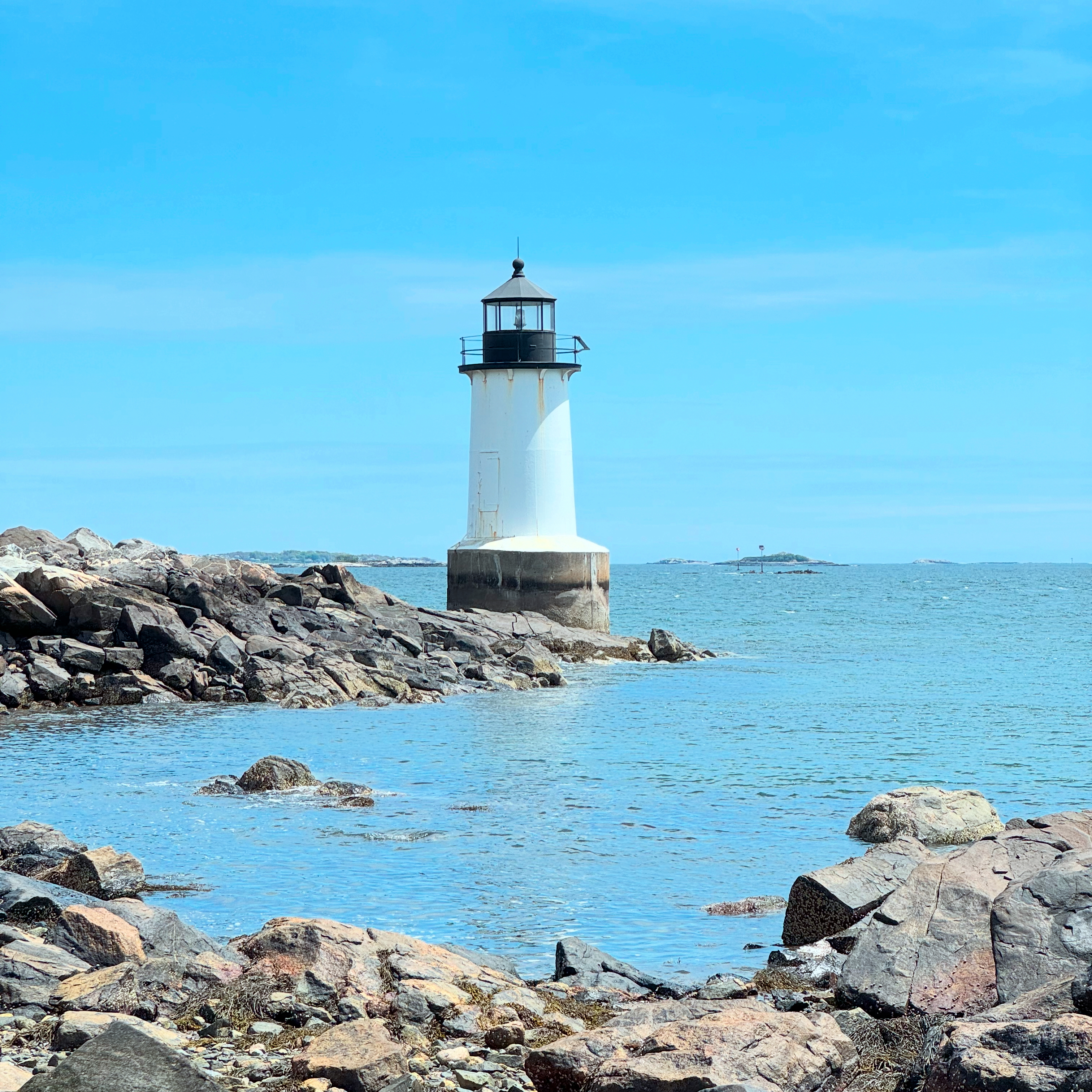
The lighthouse keeper never speaks to anyone. There is no one to speak to, and he likes it that way. His island is a speck in the restless ocean, less than a square kilometer, surrounded by rocks and pounding surf. His lighthouse is tall and solid, painted in broad horizontal black and white stripes. It is topped with a red, glassed-in room that holds the lamp and Fresnel lens.
In truth, he is superfluous. Every part of the lighthouse is automated now. He hasn’t had to do anything to it in the five years he has been at his post. He keeps his living quarters clean, cuts a small lawn, tends a small garden, and meets the small packet boat that delivers supplies every three months.
He scans the sea from the top balcony, whipped by wind. He sees an animal, a deer because he can distinguish antlers, two kilometers away, bobbing in the waves. He watches it intermittently through the morning and into the afternoon. It appears to be getting closer. The mainland is thirty-eight kilometers away, so it has been swimming for a long time. By late afternoon it is in the surf and he has navigated through the coastal boulders to meet it. He grabs it by the antlers. He tries to pull it ashore. A large wave throws them higher up the shoreline, where it lies like a pile of wet sticks. He brings a pail of fresh water. The deer drinks greedily, and eventually totters toward the lighthouse.
There is no water on the island, so the man puts out a bucket from his rain collection tank every morning. The island does not provide enough foliage to support even one deer, so the man supplements its diet from his garden and worries that it will starve come winter.
On a moonless night when the GPS shows no ships in the vicinity, the lighthouse keeper smokes a joint and turns off the light. He knows no one will notice. He points his telescope at the thick dome of stars that envelops him. The Milky Way twists across the sky above the eastern horizon. He is alone. If he sees a comet, he will smile. If he sees a comet shower, he will laugh. He makes no other sound for days at a time.
In bed he watches the blonde anchorwoman on Fox News, with the sound off. He hates her voice, her vacant stare, and her self-assurance. He hates all women. He fantasizes smashing her until she is bloodied and bruised. She whimpers and looks up at him with pleading, respectful eyes. He touches his penis, and soon has an erection. It is tall and rigid, its engorged, red head partially obscuring the TV screen. It is his own personal lighthouse, he thinks.
On Sunday morning he sits on a weather-worn chair atop the small hill in the center of the island, next to a small wooden cross he fashioned himself and painted white. He squints into the sunshine as he scans the small print from his hand-me-down Bible. His lips move silently as he reads from Romans 12: I beseech you therefore, brethren, by the mercies of God, that ye present your bodies a living sacrifice, holy, acceptable unto God, which is your reasonable service. And be not conformed to this world: but be ye transformed by the renewing of your mind, that ye may prove what is that good, and acceptable, and perfect, will of God. These words were underlined years ago by his father, and in fact the lighthouse keeper memorized them as a child. He is comforted by the familiar rhythms of the King James version and his strength is renewed.
On Sunday afternoon he smokes a joint and slips into a reverie. He sees a woman rowing a skiff ashore and disembarking on the beach. It is Sarah, his former girlfriend for two years in the small religious community where they had grown up. She had run away to the city with Rita. He had heard they were married with kids. She stands before him, her sandals planted in the sand, her chin high, her blonde hair held in place by a pink cap. She glances at the lighthouse and begins to sing as they sang in Sunday School when they were five, “This little light of mine, I’m gonna let it shine,” slowly and wistfully, all the verses.
She touches his forearm, smiles and turns away. She walks back to her boat, long, bronzed legs, cutoff denims, over-sized rainbow tee fluttering. He stumbles after her. She launches expertly, and rows swiftly out to sea. He wades awkwardly into the surf, his eyes transfixed on the straight horizon. She dissipates into the sea breeze, a figment of his memory.
He perishes without a trace. There is no one to report him missing. The ragged deer stands on the hill and looks out to sea.
 BRILLIANT FLASH FICTION