
File a Report
By H. A. Eugene
One warm summer evening a boy had the bejeesus scared out of him by an object hovering in the night sky that was bigger than the mountain it loomed over, and emanated a glow from which came an inexplicable warmth that supplanted his initial fear with a strange sense of well-being and joyous desire to share this weird, oogly experience with somebody; anybody; and so he burst through the open doors of the nearest night watch, where the officer on duty set a stack of paper forms before the boy and asked him to further describe this hovering thing, which the boy called a great and wondrous levitating rod of fire that glowed orange but also goldand thenblue, depending on how long you stared at it and what direction it pointed; but the officer only heard fire, direction, and pointed, and demanded to know what manner of weapon this was; and when the boy said no weapon, the officer leaned further across his desk and growled young man, we are at war, and when the boy mumbled something inscrutable about colors and feelings, the officer demanded he tell which side of the tracks he lived on, who his parents were, who his uncles were, who his aunts, his cousins, friends, classmates, and teachers were; and so the boy said, all you have to do is just stick your head out the window and look over there, to which the officer of the night watch replied are you threatening me? to which the boy said no; but by then it was apparent that at some point in the past this person had either too much bejeesus scared out of him, or not enough; in any case, this person was already quite afraid and had absolutely no interest in having his mind changed; and so the boy left that pile of paper and backed away from that desk as the officer stared him down head to toe; and after running out the building giggling into that warm summer night, the boy looked up into the sky, and sure enough, there itwas, atop the mountain, that weird, oogly thing, all orange and gold and blue at the same time; only now it’s landed, and bizarre indescribables oozed from pores on the vessel’s skin and rolled down the mountainside toward their sleeping town; but the boy, he could only laugh contentedly, with nothing left to do but skip home to wake his family and tell them the actual truth: that everything is fine.
Tethered/Untethered
By Jack Powers
I was thinking of killing Slim even before she started humming La Cucaracha. I don’t mean kill kill. I was just irritated. I mean nobody should have to work with their ex. We were eight hours into our twelve-hour shift—statistically the most likely time to lose focus and fall into the portal. I was questioning my life choices, lack of choices, even my choice to live at all.
And then she starts in with “Hm hm hmm ha! Hm hm hmm ha!”
“Please stop,” I said.
“Stop what?” Slim said.
“Humming La Cucaracha.”
“Is that what it is?” Slim laughed. “Thanks, Ricky!”
“Why’d you say, ‘Stop what?’ if you knew what it—”
“La cucaracha! La cucaracha!” Slim began singing. “Ya no puede caminar. That’s such an annoying song.”
“Then why keep singing it?”
All the other space portals had gone to self-service and drone maintenance, but management thought having Slim and me working would give ours a personal touch—as if we were some old Mom and Pop bodega. But our marriage was done as soon as Slim signed the papers and what Mom and Pop could afford a multidimensional deep space portal? Stupid! And two engineers scraping space barnacles and cosmic shit off the entry cone by hand? Idiotic! Balancing along the rim of the open cone with degraded mag boots but no tethers, risking falling into some unknown part of the multiverse? Moronic! Singing a centuries-old song from the Mexican revolution? Just weird!
“Porque le falta, porque no tiene marihuana pa’ fumar.” Slim had a shit-eating grin as she sang.
“You know all the words?”
She laughed. “Abuela used to sing it to me when I was little. “Ya la murio la cucaracha.” She moved closer just to bug me. “Ya la lleven a enterrar.” Her visor clouded from the heat of her breath.
“Stop it, will you?” I bumped her with an elbow–just a nudge.
She wobbled, trying to catch her balance, tipping out, then in. We were too close to the rim and our suits were old technology and a little clumsy. For a second, I thought she’d caught herself, but then she tilted way out, flapping her arms like a kid imitating a chicken. Instinctively, I grabbed her sleeve, but the momentum just pulled me with her. Out the portal. Into who knows where. The blare of the alarm fainter and fainter behind us.
When you launch into a space portal without setting a destination, where do you go? Do you just go nowhere, falling slower and slower until you stop?
I grabbed Slim’s wrist with my free hand and she pulled me into a hug. The first hug we’d shared in years, and it felt good despite our predicament. I pressed into the warmth of her. The old suits weren’t designed for this kind of cold.
As we slowed, the blurring stars sharpened into distinct points. We faced forward, cheek to cheek, staring into the vastness of space. It was wildfire beautiful. Awe-inspiring, but lethal. We were definitely going to die.
“Did you have lunch?” Slim whispered into my ear.
“Lunch?” I pulled my head back and it sent us into a soft tumble. “Seems like we got bigger fish to fry here.”
“Don’t say fish.” Slim licked her lips. “I left an ahi tuna salad in the fridge.”
She’d always been a stress eater. If you age more slowly in space, shouldn’t you get hungry slower too?
***
I think a lot of fatal accidents are caused by people who don’t care enough about their lives to be careful. We seemed to be an argument for that. We tried to settle on our backs, both hands clutched awkwardly across our bodies, and stared at the vast array of space junk. A comet’s flotsam might kill us before the hunger or the cold.
“Holding hands is getting uncomfortable.” Slim wiggled her gloves. Or maybe she was shivering.
“We’re not going to stay together without a little work,” I said and pulled her closer. “If we separate, it’s forever.”
Slim unclasped one hand, pulled a cable out of her tool pocket and clamped it to both our waists.
“We need a backup,” I said, still clutching her other hand. “What if this fails?”
She pulled out another cable, tied it to our shoulder harnesses and smiled her big can-do smile—the one I first fell in love with. She can fix anything.
“But I like holding your hand.”
She squeezed my hand affirmative.
“We’re going to die,” I said.
“Ricky!” She sighed. “We were having such a nice moment there.”
“I know, but—”
“Shhh!”
In the distance an icy comet flashed white. The transponders on the back of our helmets pulsed red in unison. It was freezing, but so nice without all the disputes and distractions, I almost wished they wouldn’t find us. At least right away.
***
There isn’t really a word for how vast space is.
“Immense?” Slim offered.
“No.”
“Gigantic?”
“I think that’s smaller than ‘immense’.”
I took a deep breath and checked my air: 40%. “Maybe we should reduce our oxygen a tad so we can last longer?”
“Sure,” Slim said. “I’d like to last longer.”
I wiggled my numb toes. “They could still find us,” I said. “If these transponders are working.”
“Now there’s some positive thinking!” She’d stopped shivering.
“Hm hm hmm ha! Hm hm hmm ha!‘ I hummed and she smiled.
We floated in silence.
“I’m getting sleepy,” I said.
Slim mumbled something and her hand loosened its grip. She was already asleep. She rolled on her opposite side, her back facing me. I tested the tethers, then rolled the other way.
“Sleep tight, bebé,” I said, patted her hip and thought of our honeymoon night. After the I-dos and the dancing, the crowd waving as we drove off, the drunken lovemaking, we lay just like this, heinie to heinie, as I struggled to stay awake, not wanting it to end.
Hammering Home
By Sean MacKendrick
One Thursday afternoon, a few years from now, Rodney will see the claw hammer and pause as his mind wanders back to the many projects that hammer helped him complete, and he’ll think about how he managed to find time for those projects even after working a full day, and how he used to have more energy. For a moment he’ll forget about the spare batteries he came in here to find, and instead he’ll remember how carefully he once centered the nails that hold the big family portrait over the mantle, and putting up shelves in the living room for their burgeoning collection of road trip tchotchkes, and building that playhouse in the back that they finally scrapped the summer prior now that the kids were all grown up, and he’ll wonder when exactly he last placed the hammer on its pegboard. And then he’ll remember fixing the breakfast table which sits upturned on the shop’s bench in front of him right now, sporting a newly sturdied leg.
On that day in the future, he’ll recall how the hammer used to feel in his grip, both when it gleamed silvery new, and after a few hundred hours of good hard use wore away parts of the rubber grip, now held together with electrical tape. He’ll pick up the hammer and be surprised by how heavy it sits in his hand and will reflect on how it didn’t weigh much at all, once. He’ll run his thumb over the metal head and give it an experimental tap into his palm. The appraisal will trigger the slightest shiver of envy as he confirms the old tool is still strong and sturdy and just as useful as it always was, and he’ll put it back in its place before that line of thought gets to weighing him down and ruins his day.
All those things will run through his head on a distant Thursday. Today, here and now, Rodney doesn’t give it any sort of thought whatsoever as he hangs up the hammer and drags the small table back inside the house so they can have eggs together without the table wobbling all over the place.
The Lavender Scare
By Lisa Lahey
The two men who lived in Apartment 206 called themselves confirmed bachelors. Everyone else called them lavenders. It was 1952 and they sat on the front stoop of my apartment building in the Bronx every day, watching people walk by.
Mr. Cavelli was twenty-three, which, because I was eight, seemed ancient. He was tall and thin, with a scar running from eye to mid-cheek. His friend, Mr. O’Malley, was shorter and chunkier than him, but had powerful shoulders and bulging arms. He had copper hair, a full beard, and a sparkle in his blue eyes.
“Those two men who live in Apartment 206, Melissa,” Mama said, her eyes flashing. “They’re lavenders.”
“What’s lavender, Mama?”
“Men who live together. Stay away from them.”
During dinner, Papa and Mama talked about something they called The Lavender Scare.
“They’ve every right to fire those people,” Mama said. “I don’t want them working for Congress.”
“Sylvia, McCarthy has no right to conduct a witch hunt here. I have no problem going after the Reds,” Papa said. “But the lads aren’t doing anything so bad.”
“They’re morally deficient! It’s an abomination against God!”
“What’s abomination?” I echoed.
“Melissa, take your dinner and eat it in front of the television,” Mama said.
I didn’t know what I’d done wrong, but I did as I was told.
“Apples and oranges, Sylvia,” Papa replied. “One is a moral issue, and the other is political. You shouldn’t blindly agree with everything McCarthy says. That man’s a reckless bully.”
“Maybe we need a reckless bully to protect this country.”
***
Jacob Wallace, a Black boy who lived in my building, was my best friend. Jacob had large, mahogany eyes that always bore a hint of sadness. Sometimes he had faint bruises on his arms and legs. When I asked how he got them, he always said he fell out of bed.
We played together almost every day. Jacob was especially good at hide-and-seek. I could never find that kid. He made himself so small in the nooks of the buildings around us, that it was impossible to find him. It was almost like he practiced hiding by himself.
Every morning, I knocked on his door so we could go to school together. There were days when Jacob’s mother only opened it a crack.
“Jacob has the flu,” she’d whisper.
“Okay,” I’d say and leave without him.
Whenever I left Jacob’s, I had to pass by Apartment 206. I heard jazz music coming from inside and a real trumpet playing along with it. One afternoon, Mr. O’Malley stepped outside, carrying a trumpet case and a file folder filled with sheet music. His back was turned to me, and I saw that his huge, strong arms were rail thin. His pants hung off his lean frame. There were bags beneath his blue eyes, and they didn’t sparkle anymore.
“I’m off to band practice, Melissa,” he said, as if he owed me an explanation. “Enjoy your day.”
I watched him walk slowly downstairs. His shoulders were slightly slumped as if he’d aged many years.
He reminded me of Jacob when he had the flu.
***
One morning, two police cars pulled up to my building. I walked up to the front stoop and saw that neither Mr. Cavelli nor Mr. O’Malley were sitting there. Mama ushered me inside.
“Did you hear anything about the men in Apartment 206?”
I shook my head. Mama took me by the hand, led me to the sofa and sat me on her lap.
“Dear, I have to tell you something that will make you very sad, but it’s best if you hear it from me.” She paused. “Jacob went missing today and the police are trying to find him.”
I turned this over in my head, then I burst into tears. Mama rocked me back and forth, murmuring words of comfort.
Everyone in the neighborhood decided the men in Apartment 206 were responsible for Jacob’s disappearance. But I found it hard to believe that Mr. Cavelli and Mr. O’Malley had anything to do with Jacob’s disappearance. They had never been a threat to me or Jacob.
Two weeks after Jacob disappeared, I noticed Mr. O’Malley was skinnier than ever and terribly weak. He’d lost his copper hair, and he wore a ballcap to cover his head. I ignored Mama’s warning about him and sat down on the stoop.
“I suspected long ago that Jacob’s father wasn’t being nice to him,” he began, without so much as a hello. I called the police, but they don’t take lavenders seriously.”
“Do you think Jacob will come back one day?”
The corners of Mr. O’Malley’s mouth turned downward, but he said, “it would be nice.”
The last time I saw him, an ambulance carried Mr. O’Malley out of Apartment 206 on a stretcher. He had an oxygen mask on his face. Mama spied on him through the window, but she didn’t say a word to me about Mr. O’Malley or Mr. Cavelli.
I came home from school one day and found Mr. Cavelli sitting on the stoop alone.
“Hi, Melissa. How was school?”
I looked at him and saw he had the same sad brown eyes as Jacob. On impulse, I sat down beside him.
“Are you okay, Mr. Cavelli?”
“They couldn’t get it all, Melissa. It was too late.”
Tears rolled down his lean, white face. On impulse, I grabbed Mr. Cavelli and hugged him.
“Thank you, Melissa,” he whispered. “No one else talks to me.”
A month later, Mr. Cavelli moved away. People said it was because his guilt was eating at him about Jacob. The Wallace family moved soon afterward. People said it was because the memories of their son playing in the neighborhood must have been too difficult to bear.
Eventually, people forgot about Mr. Cavelli and Mr. O’Malley, and they forgot about Jacob too.
It was as if Jacob Wallace and the men in Apartment 206 had never existed.
The Dragon
By Margo Griffin
My eyes burn as I hold back another eye roll, standing on the front stoop of the home I once shared with my wife and kids.
“Smarten up and grow up, or you’ll end up all alone like your father,” my ex-wife says.
“Come on, Dina, not again … not now,” I say, glancing over at our two young boys waiting by my car.
“I swear on my mother’s soul I won’t even let you take these kids for a Saturday drive anymore if you don’t get your act together,” she insists, stepping closer to me, checking for a whiff of booze.
I nod at her empty threat and tell the kids to kiss their mother goodbye. Then, the boys climb into the back seat of the dragon, a 1974 Red Volkswagen Beetle.
I’ve gotten smarter since the divorce and keep mouthwash in my console. I cover up the cigarette burn holes and the half-empty six-pack of Budweiser beer with the blanket I left on the car floor behind the front passenger seat. I’m not my father. I didn’t desert my family; Dina threw me out.
The dragon rumbles angrily, roaring as I drive away. Soon, I hear my kids making up stories about me, their dad suited up in a quilted silver coat and wielding a plastic snowbrush as a sword to trap the ancient creature within the car’s steel. This version of me makes me feel invincible.
Two weeks from now, I accelerate too fast while stretching my neck to read a funny bumper sticker on the speeding truck in front of me, just as the teenage boy riding the dragon’s tail gets distracted by a tube-topped girl at the bus stop. The teenager’s car rams into the back of the dragon and cracks open the steel hatch that separates my kids from the dragon’s ire. Flashes of Dina and me at our wedding and the birth of our children flood my mind. I wallow in a river filled with regrets like the afternoon I left the kids in the car for two hours while lost in the Casino’s flashing lights, and the night Dina found me in my car behind Walmart with our old neighbor Kimmie Marshall on my lap. Then I turn my bloodied, battered face toward the sounds of screaming kids and rattling empty beer cans. The bumper sticker’s message, Disco Sucks, will slip out of my lips in a sad, husky whisper just as the dragon pushes its head out of the car’s belly and opens its hellish mouth, engulfing us in its fiery breath.
But today, my eight-track tape crackles in the background, and we bounce along the streets like we’re on a rollercoaster, my kids screeching with laughter from the thrill of every crack, pothole, and bump I’m sure not to miss. Then, the three of us sing Born to Be Wild from the top of our lungs, only disappointed when we turn down Elm Street back toward the house.
I pull away and head down the street alone, my heart aching with the loss of my kids when, suddenly, the dragon’s exhaust lets out a BOOM like a warning shot, shaking me to the core.
Upriver
By Lindsey James
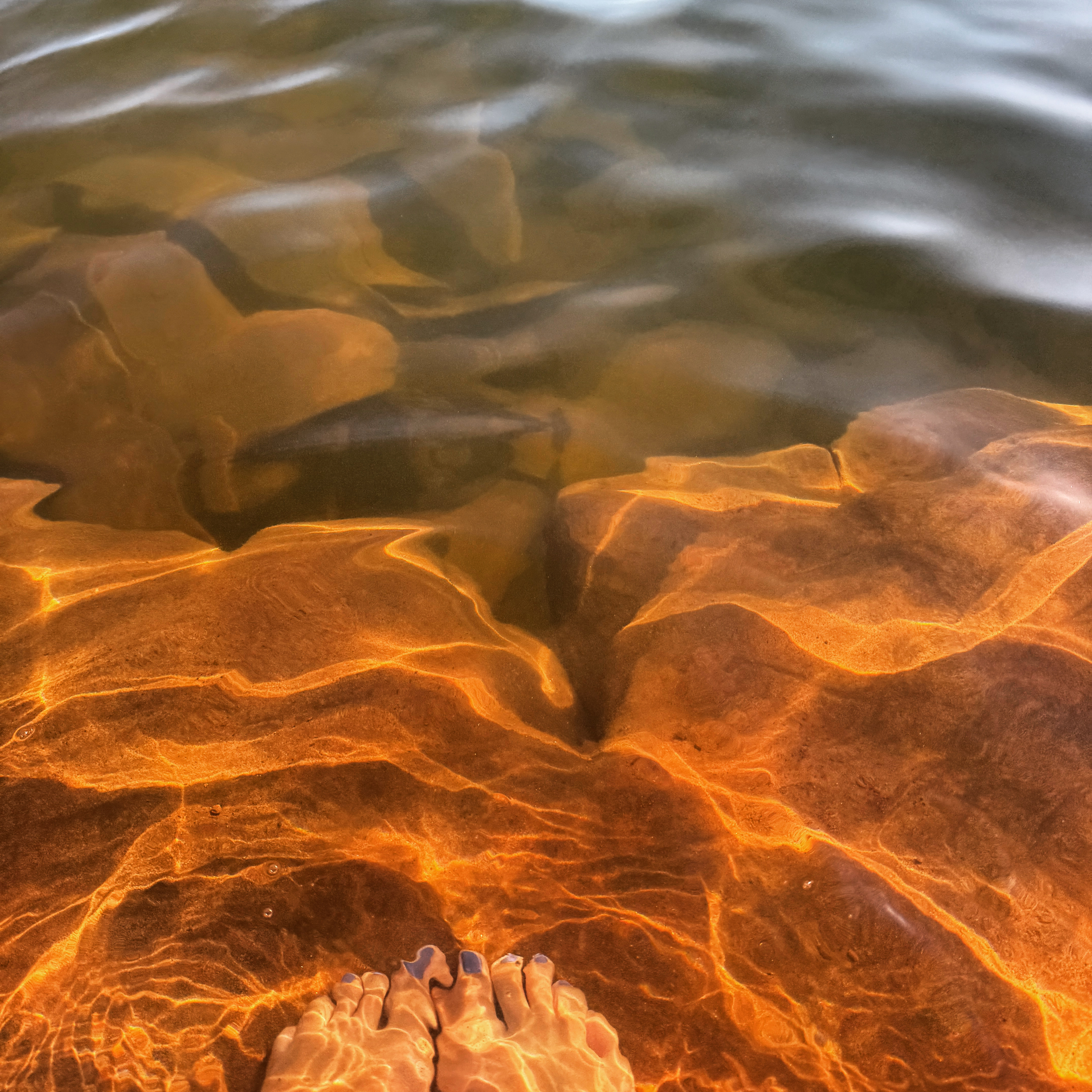
Minnows suckle our toes. You sweep them into your bucket, but they flow over the rim, uncontainable. You scoop sand from the river bottom, swirling until flakes of fool’s gold break free. You pour the sand into blobby castles, then dig an eroding moat that reclaims the sand. Sand infiltrates all your crevices—later I’ll find it under your toenails, in your trunks, between your teeth.
Behind a stand of poplars just downstream, where the water hiccups its fast gallop across rocks, a harmony of shrieks rises. You look up. “Sounds like fun down there.”
There’s a request in your voice, a wistfulness I pretend not to notice. “It’s fun here, too.” I dribble a wet handful of sand over your toes and you giggle with the tickling cold. You want other kids to play with, I know. Would rather be part of their cacophony. But the truth is my body’s gone languid with the heat and I can’t summon the will to move or to cover myself up for other eyes. The truth is I’m greedy with the pleasure of watching you play. The truth is it’s safe here in the shallow pool tucked above the rapids. So I keep you upriver, to myself.
We toss rocks into the water, pointing to guess where their ripples will meet, but I keep catching you looking longingly downstream. The shrieks shift in pitch, jarring against the whistling kingfishers, the rustling leaves. I remind myself not to call the kids hooligans. Not to judge their parents for letting them run wild. If the parents are even watching. Some of the afternoon’s perfection has leaked away. It’s time to pack up—now, before the bitterness at the back of my tongue bleeds out, poisoning the rest of our day. You’re overtired anyway; you whimper and shove my arm away when I brush the grit from your skin.
As we head downriver toward the parking lot, the plush sand underfoot hardens. You hold the tail of my t-shirt in your left hand and the bucket in your right, your toe knuckles white from gripping the rocky ground.
Closer now, the shrill voices take on textures of gravel and desperation. My feet falter, gut knotting with the uncertainty of what we’re about to see. But there’s no other way around. Through the trees, figures flicker into sight, registering in flashes. A wild-eyed woman, hardly taller than the girl she grips by the shoulders, water streaming from the hem of her tequila-logoed t-shirt, wrapping her knees in silver ribbons. A scattered handful of children, sunburned and stunned.
“You could’ve—” The woman shakes the girl, violent in her relief. “Could’ve. Could’ve.” The word is a cough, but she can’t hack up the maybes. Can’t speak them into being. She turns and spits a mouthful of river into the sand. The girl’s skin has gone skim-milk blue under her mother’s grip, her lips violet; the ghost she will someday become has breached the surface.
I clutch your shoulder, holding you back, shielding you with my body: There are things you shouldn’t have to know yet, like how spiderweb-fine the line is between almost and after.
I want to offer the woman something. Reassurance, maybe. Or to keep an eye on her kids while she regathers herself; one of them has toddled over the lip of the riverbank, small waves lapping against his knees. But then the woman turns and spots me. In the force of her glare I can see I’m nothing but a gawker, an interloper in her moment of crisis. I can see she wants nothing I have to give. I wince her an apology before hustling you back to the car, clutching the reprieve, the glassy, shame-laden gift of it, to my chest.
We drive through the dregs of downtown. When I glance in the rearview, you’re leaning against the window, eyes stuck shut with sweat and half-shed tears. You don’t see the kids belly sliding across hose-drenched tarps or playing hide and seek behind rusted-out cars. You don’t see them drop their squirt bottles to dart into the street after the off-brand ice cream van. You don’t see their quicksilver smiles and sun-flashed skin, so you’re safe this time from the envy of their heedless, hurtling joy.
The air conditioner kicks into gear as we climb the hill. The street numbers increase; patches of pigweed and crabgrass are replaced by squares of waterlogged lawn. We drive up and up and up. Kids here play behind fences.
“It’s fun here, too,” I say again, keeping my voice low so you don’t wake. At the turnoff to our street, I hesitate, wishing for more altitude. If I could carry you higher, I would, all the way to where street meets sky.
The Den
By Marian Mitchell Donahue
The daughter of the house and her friends have taken over the den. The plush brown recliners have been pushed to the side and piled high with their backpacks. Beer has been replaced with chemically bright sodas, the bar covered in pale pink bunting that spells out ‘Happy Birthday.’ The racially insensitive but still popular mascot in the center of the carpet is covered by a well-washed paisley comforter. Six girls on their bellies in a circle on the floor, heads lowered, sideways glances to the open mouth of the stairwell that may at any moment betray them, carry their voices, their secrets, back up to the excluded world.
They’ve come with their best. Matching pajama sets, tiny bottles of their mothers’ face wash, name brand characters splashed across their sleeping bags. The only way to find their rank is to push as far forward as they can before they’re stopped by someone meaner and stronger than them. The girls who menstruate condescend to the ones who don’t. Some already Nair. Everyone takes turns doing jumping jacks so the assembled committee can vote on whether it’s time to ask her mother for a training bra. They always tell the truth. The ugliest one knows who she is. The stupidest one never guesses. The prettiest one’s father flipped his car twice in three months and now she only sees him twice a year. She spits when she calls him a fag. The stupidest one has her moment. She asks if the pretty one even knows what fag means. She says it’s a really bad word for a gay person. The pretty one shrugs. He’s a bastard then. The six agree. A bastard.
That one’s older sister implied she likes having sex with her boyfriend on the old Care Bear bean bag chair in their playroom. That one has a friend who said she went to a sleepover where the girls passed around a plastic you-know-what and practiced on it. No one asks if she did too. They exchange stories of strange men in cars. Walking home from school, playing in the front yard, waiting for pickup from ballet class. The men want directions but can’t hear them from all the way over there. The men want to know where their mommies and daddies are. Then come the secret promises. We would notice right away if you were gone. We would scream. If someone were to break in tonight and tried to rape you while we all slept, like those girls on the news, we wouldn’t pretend to be asleep while we waited our turn. We would fight to the death. The Birthday Girl brings them all behind the bar to see where her father keeps the steak knives in case they need it. They each pull one from the block, feel it, then slide it back. The Birthday Girl pours all four flavors of soda in one of her mother’s heavy crystal chalices. Pass it around and drink.
During the Blitz
By Jeff Burd
I was in year three when Mum wrote my name on my parts. She started with K-E-I-T-H in bold, dark letters from inside my elbows to my wrists. The Luftwaffe had bombed my school the week before. Fear shot through me when I saw the pile of rubble—certainly I would get blown up, and then how would Mum ever be able to reclaim my bits? She reasoned that if my parts were labeled, she could reclaim them. I wondered how she would know I was her Keith and not some other mum’s Keith, but I didn’t ask because I saw how she knitted her brow when she took her fountain pen from her lap desk and printed my name with her steady hand.
She rolled my sleeves down to my wrists when she was finished. “Stay buttoned,” she said as she did my cuffs. “We don’t want people to think you’re dirty.” She held my face in her hands, scanning me cheek to cheek and eyes to chin the way she always did when I brought my worries to her. Seeing the concern washed from my face, she kissed my forehead.
I saw Peter and Roger and John at the pile of school rubble the next day. We’d gotten into the habit of meeting there most days to chuck bricks. I showed them the ink on my arms, earning their respect when I said they were real tattoos I would have for the rest of my life.
“Unless your arms get blown off,” Roger noted.
Peter nodded. “Good idea, mate. You’re lucky to have your mum.” He’d heard about a year four lad a few neighborhoods over who got blown to bits. His mum and dad were still looking for pieces of him. The only explanation he offered was that the poor bastard didn’t make it to the Tube in time after the sirens went off.
That night, my mum printed my name from behind my knees to my ankles.
“They’ll just sew the parts back on, right?” I asked her the next morning as we were climbing the steps out of the Tube.
“Of course, dear,” she told me, pulling me close. I could feel her warmth, even through her coat.
Two days later, the lads showed me their arms. The bloody liars claimed tattoos, too. Not to be outdone, I showed them my legs. When I told them about sewing our parts back on, John spat.
“Bollocks,” he declared. “Your mum will gather what she can find so she bury you with as many of your parts—”
“They can do that!” Roger cut him off. “Saw it in a magazine.”
When we met the next week, Peter brought a bucket of murky water. “We’ll swap names,” he said. He pulled a brush out of one pocket and a dirt-streaked sliver of soap out of another. He rolled up his pants and scrubbed both legs, and then rolled up his left sleeve and did that arm. “Keeping my righty,” he said. “So I can throw darts with my old man when he returns.”
The rest of us took turns scrubbing. I saved my left leg because I planned on being a striker.
I nipped home and returned with Mum’s fountain pen. We took turns writing our names on each other. Everybody got “Keith” on their left arm. My right leg was John. Roger and Peter were my left and right arms.
“Brilliant!” Roger announced when we finished. “They can sew us onto each other if we get blown to bits and they can’t find all our parts.”
Peter nodded. “Mates forever.”
John’s face was painted with doubt. “The city better get ready for a bunch of kid Frankensteins running around.”
I wished he hadn’t said that because it stuck in my head something awful. I dreamed three nights in a row that I couldn’t control myself as I ran the pitch. Roger and Peter’s arms or John’s leg kept flying off me. Mum was on the sidelines with her face buried in her hands. Her body was heaving. I kept running over to her calling out, “I’m okay! I’m all right!”
That third night I put her hands on my face. “I’m still your Keith!” I told her. Her jaw trembled as she struggled for words. When she finally managed to open her mouth, the wail of sirens flooded my ears.
I woke to the same sound blasting through the night air. I was sweating and shivering under the covers. Mum was standing in the doorway of my room with my coat in her hands. I rushed to her to find her warmth. We hurried to the Tube.
A Nice Grave to Nap in
By Alex Juffer
Cali’s grandfather’s new wife dies just across state lines so we drive over. It’s a beautiful day for a funeral, sunny with a muted breeze, and it makes me so damn jealous of the woman being buried.
Cali pours wine into a plastic water bottle, crinkled from use, and sips while I drive. After she naps, we switch places and I drink the wine which is warm and sweet and reminds me of skipping high school. When it’s gone, I find a handle of liquor that tastes like molasses and lighter fluid under my seat. I want to slip right into the sunshine but Cali is listening to an audiobook about the French and Indian War.
Cali drives right at the speed limit and I tell her we’ll be late.
“Won’t matter if we end up in a grave ourselves.”
I say nothing. She waits for the counterargument. That’s what we do, really: argue, make up, have sex. I’ve been in worse relationships. We have great arguments.
I roll the window down and let the wind whip my mind clean.
***
We show up right as they’re lowering the casket. Cali spots her grandma, the ex, and collapses into a hug. Her grandma wears enough bangles to swallow up her thin wrists. She hugs me too. Perhaps out of grief, perhaps mistaking me for Simon, Cali’s ex-boyfriend who had a steady job and moral compass he liked to take out and show everyone.
I don’t feel so steady myself, but I like hugging a woman with some history. We hold each other until Cali taps my shoulder.
Despite most people rocking sunglasses to ward off the sun, I sense them glaring at us. Cali and I are wearing Canadian tuxedos, unintentionally matching. I forgot how solemn we tend to be to see the dead off, or I never knew. The mourning is sobering.
I feel faint and head to the bathroom to sip from my flask.
***
A week ago, I found a bulge in the back of my neck, like I had swallowed an egg whole. I didn’t tell Cali because I knew she would make me go to the doctor.
Since I found it, I wake up every morning and think: this could be my last day. And yet, I do the same shit. I like my little life. People have been telling me to get sober for fifteen years. If you don’t like me drunk, you’d hate me sober, but they don’t want to hear that. A man needs a habit in life to manage or else it’ll just be him and his thoughts and then you really have problems.
***
We wait until the grounds crew finishes mowing and then let ourselves into the cemetery. We split a twelve-pack, seven for me, five for her, and fall asleep in the cropped grass under a tree, her chin in my clavicle.
I wake up to Cali kissing me. She likes doing this—coaxing me out of a deep slumber with gummy morning lips. Her hand caresses the back of my neck. She must feel me stiffen as she runs her hand over the lump. We separate; she sits back on her haunches.
“What is that?”
“It could be anything,” I say.
“You’re dying,” she says, in awe.
“Well, you’re right there with me.” I shake one of the empties.
“Don’t give me that ‘we’re all dying’ bullshit.”
“It could be anything. It could be a bad reaction to a bee sting.”
“Stop.”
“The bees are after me. You know how much I like honey.” I try to remember how Pooh Bear talks.
“Stop.” She’s crying now, I realize, tears sticky on her cheeks. It makes me feel bad, and I don’t want to feel bad, so I get up and knock the dirt off my jeans.
“You’re dying,” Cali accuses.
***
I walk down the street until it becomes a highway leading out of town. There’s a hotel, and inside the hotel there’s a bar with one other person inside—an old timer that’s familiar enough.
I sit down next to him and order a Bud Light, same as he has. I ask him how his day is going. He tilts his head, eyes never leaving the TV that plays golf highlights.
“My day isn’t so hot,” I say. “My girl just found this and freaked.” I gesture to the bump.
He stands up and squishes it between his fingers. I want to squirm but sit still as he prods. The bartender pretends to clean dishes.
“Boy, that ain’t nothing but a lipoma,” he tells me and sits back down. His collared shirt is tucked into his jeans, and his jeans are tucked into his boots.
“How do you figure?”
“I’m a doctor. Or was.”
“A lipoma?”
“Yeah, lipoma. Fatty mass.” His casualness gives me confidence. He motions to the bartender for a second.
Tears leak out of my eyes and I feel weak with happiness. I hug the side of the man, perched on his stool. He watches TV, sips his beer, and shrugs me off.
I walk outside with the cold Bud Light in my hand. It’s all cars and concrete and me.
“Lipoma!” I scream at the sun. The birds take to the sky.
***
I zigzag the tombstones. The day is clear with no visitors except two squirrels. I chase them around until I lose my breath. Eventually, I stumble upon a new grave, recently dug, dirt piled at the edge like a war bunker.
I hop into the hole and lay down in the packed dirt. It’s deeper from down here. I settle into the damp earth where the air is cool and heavy, pulling me towards a nice, restful nap. I can’t wait to tell Cali the good news. I hope she found a drink for herself.
I’m not afraid of being buried alive; I know the dirt hitting my face will wake me.
OEDIPUS NOW
By Antoine Bargel
(Based on the testimony of Bui Minh Duc.)
On March 28th 1954, the French paratroopers launched a counter-attack on our position. I was just returning to my section with our daily rations of rice when the shooting started. Immediately, I grabbed my rifle and ran toward my fireteam. Lam, our leader, and Thanh, a new recruit two years my junior, were already firing at the approaching enemies. I joined in without a word, propping my back against the edge of our fighting hole, then turning around to shoot, folding back to reload.
After their initial advance, the paratroopers were now digging in as well, establishing a position about thirty yards from us. The shooting was relentless and there were already many dead on both sides. Soon, Lam was hit in the throat and fell to the ground, the blood from his wound first a powerful pink spray, then a progressively gentler gurgle of a liquid dark as mud. I felt a surge of panic, looked around quickly: there wasn’t anybody in charge anymore. Everyone was too busy shooting and trying not to get shot. With a knot in my gut, I reached over and took Lam’s machine gun and ammo. The blood from his throat was still flowing out, but his eyes were already set and glassy.
I checked that the machine gun was functional, then began firing. The recoil was considerably more powerful than with my single-shot rifle and I struggled at first to keep aim at the correct level. With my heart pounding and the deafening roar of battle all around, it took all my focus to remember what little training I had received in automatic weapons. But soon, applying the correct amount of pressure with my palms, I was managing to fire short, precise bursts at the French soldiers whose dark silhouettes rose above the horizon.
I looked to my side and realized that Thanh had been shot as well. There was a small hole in his chest and he was staring at the sky, not dead yet, breathing hard, grimacing with pain. He saw me looking and returned my stare for a moment, hanging on as long as he could, then closing his eyes. A spray of bullets hit the ground behind him and I lowered my head, checked my ammo, and again turned around to fire.
Soon, there was a pause, ending the first wave of the attack. I saw that eight of our twelve-man section were down, dead or wounded. I moved over to where the next fireteam had been and propped their machine gun back up, so that I could go back and forth and shoot from both angles. Further down the trench, I saw Phuong, our medic, lifting an injured comrade on his shoulders in order to carry him to the rear. Then the second wave started and I was constantly dodging, firing, switching stations, expecting to get shot at any time but determined to give it my all. I don’t know how long it lasted. At some point, the noise subsided again and I still wasn’t hit. But I was the only one left from my section.
Breathless, fighting the need to collapse to the ground, I considered this nightmarish sight: all my comrades taken out. A few were still moving feebly, most were dead. Everywhere, blood was flowing, making rivers and lakes in the soil. Flies were beginning to feast. Further to each side, the other sections barely fared better: I saw a few soldiers who, like me, had organized multiple positions from which to continue fighting. Among the wounded, those who could still move prepared grenades and reloaded guns. I saw Phuong coming back toward me and just then, a major explosion shook the ground and sent mud and human flesh flying all around.
It was the third wave of the attack. Forty yards out, I saw enemy soldiers advancing. I gestured to Phuong to join me, then began firing again. There were more explosions all around us. I stayed stuck to the ground and still wasn’t hit. But I heard Phuong, behind me, say: “My arms, I’m injured.”
I told him: “Go get cover, I’ll manage!”
But I had spoken too soon.
I heard a sudden clicking noise, then everything went dark. For a few seconds, I didn’t know where I was, then I started checking myself. I didn’t have any major injuries, only blood flowing on my cheeks, and I couldn’t see. I called Phuong and he said: “My Goodness! Your eyes!”
His tone of voice told me that it was serious, but I didn’t feel the pain until much later. I said: “Look, I still have my arms, I’ll shoot. You still have your eyes, tell me where.”
Phuong replied: “Ten enemies! Thirty yards out, right ahead.”
I emptied an entire clip, applying the same amount of pressure with my hands as I had before, trying to reproduce the exact same movements.
Phuong said: “Well done! They’re retreating! Shoot again! Right and left!”
I emptied a second clip. I couldn’t see anything, but I imagined bodies falling until all that remained was the horizon, a dark shadowless line under the burning sky.
Just then, another company from our battalion arrived to reinforce us. The enemy attack had failed. Phuong, who had lost too much blood, would die soon after. A medic bandaged my eyes and guided me back to a field hospital. It had been my first firefight in the war of resistance against the French, and was also the last.
 BRILLIANT FLASH FICTION